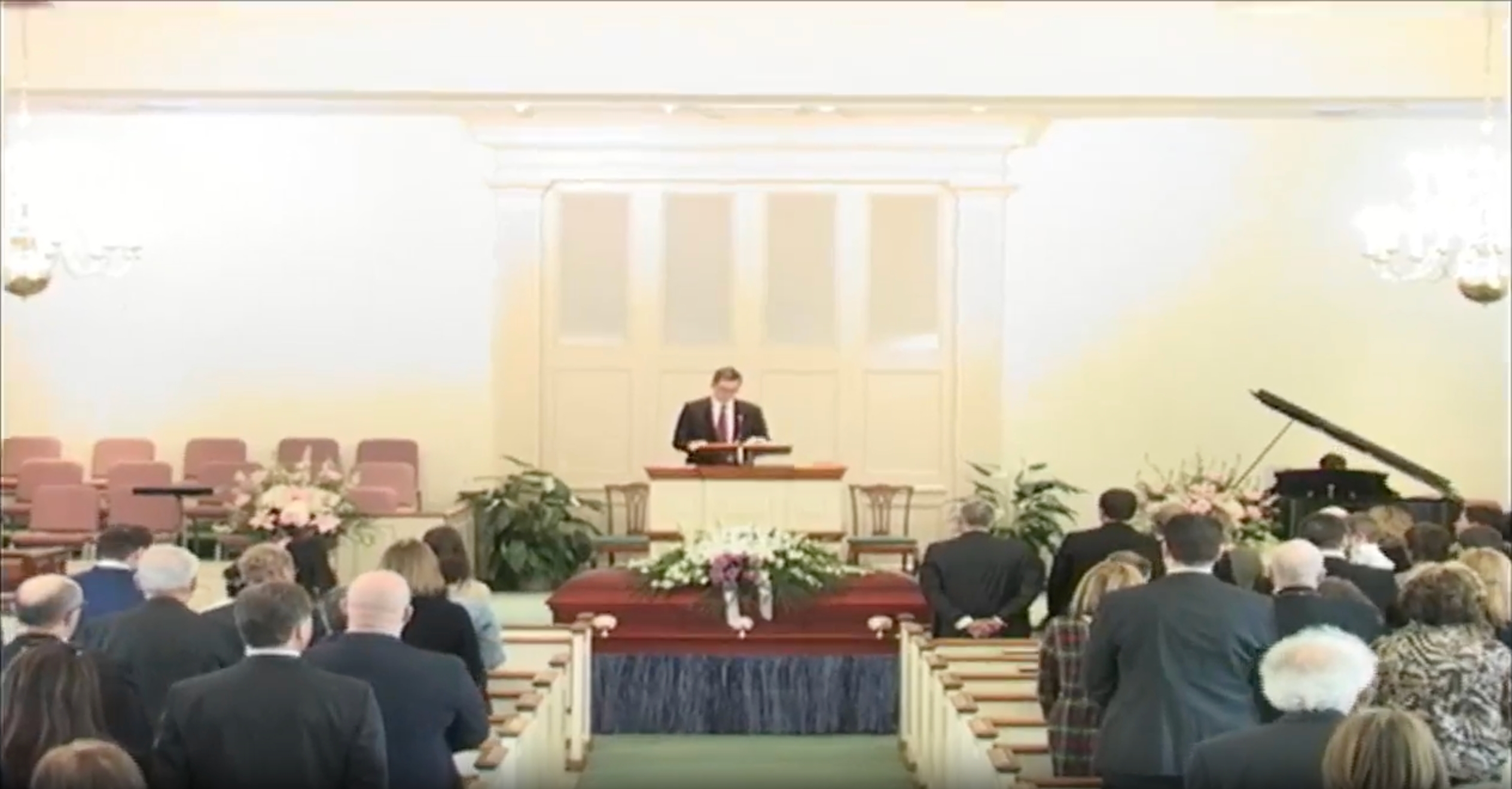
This is a lightly edited transcript of a funeral sermon for Marion Crumplar. You can watch the entire sermon below.
Revelation 21:1-8
[1] Then I saw a new heaven and a new earth, for the first heaven and the first earth had passed away, and the sea was no more. [2] And I saw the holy city, new Jerusalem, coming down out of heaven from God, prepared as a bride adorned for her husband. [3] And I heard a loud voice from the throne saying, “Behold, the dwelling place of God is with man. He will dwell with them, and they will be his people, and God himself will be with them as their God. [4] He will wipe away every tear from their eyes, and death shall be no more, neither shall there be mourning, nor crying, nor pain anymore, for the former things have passed away.” [5] And he who was seated on the throne said, “Behold, I am making all things new.” Also he said, “Write this down, for these words are trustworthy and true.” [6] And he said to me, “It is done! I am the Alpha and the Omega, the beginning and the end. To the thirsty I will give from the spring of the water of life without payment. [7] The one who conquers will have this heritage, and I will be his God and he will be my son. [8] But as for the cowardly, the faithless, the detestable, as for murderers, the sexually immoral, sorcerers, idolaters, and all liars, their portion will be in the lake that burns with fire and sulfur, which is the second death.” (ESV)
Marion was a beloved daughter, sister, wife, mother, grandmother, and friend. Her life was a gift from God, and she will be dearly missed. It is undoubtedly true that many tears have been and will be shed as we mourn and remember her passing.
So the question is, what are we to make of the passage of scripture that we just read? Where we read that, “He will wipe away every tear from their eyes and death will be no more. Neither shall there be mourning, nor crying, nor pain anymore, for the former things have passed away.” What are we to make of this passage, which describes, I think we can appropriately use the word, a utopia? In our common usage of that word, a utopia describes a place or a world where there are none of the things which mar human existence in life.
Utopia: A No Place or Good Place?
The word utopia was coined by Thomas More in his book by the same name. It was actually a bit of a play on words. He was a Greek scholar, and he used two different Greek words to form this new word, utopia. A play on taking the word, ou, the word for “no”, and the word top from topas, the word for place. Topos is where we get the word topography. So he took the word “no” and “place” and put them together to form the word utopia–which literally means “no place”. Utopia is a no place! It is a place that does not exist, for which we have no experience. We do not know what it is like to live in a world with no tears, no mourning. It’s something with which we have no experience. We do have experience with pain, death, and suffering. Sure, there are many good things in this life, many things which we are very thankful for, but the reality is that every life, no matter how long or how short, ends in a tragedy. And often the 2.5 billion heartbeats that go between the first beat and the last are filled with much heartache as well.
But as I said, Thomas More, when he coined this word “Utopia” was making a pun in Greek. Because there’s another way you could form that word in Greek, spelling it slightly differently but pronouncing it the same way. And that is by taking the word for good, “eu”, instead of “ou”, and putting them together with the word ”topos” to form the word eutopia, a good place. So Moore, even in his title, is asking the question, is utopia a no place or a good place? Is it an “eu” place or an “ou” place? Or, more poignantly, is there a way that something that is currently a no place becomes something that is a good place?
How the Eutopia Became a Dystopia
This question could summarize the story of the entire Bible from Genesis to Revelation. You can’t really understand what is going on in Revelation 21 without talking at least briefly about what goes all the way back in Genesis 1. For this consummation is the consummation of what began at the beginning. For we’re told in Genesis 1 that in the beginning God created the world as a good place. It was a good place where God had created men and women to be in perfect harmony with their creator and consequently also with creation.
So how did this eutopia, this good place, become an outopia, a no place? Well again, the answer lies in the beginning of God’s Word where it describes how everything that is broken and wrong and doesn’t match up with being called “very good” stems from the fateful choice humanity made at the very beginning, where we decided that we didn’t want to live in harmony with God as our ruler, but we would rather be the ruler ourselves. We rejected him as our God and decided to live our own way in defiance of him, something the Bible calls sin. And the Bible goes on to describe how when we break away from God as our king, as our ruler, and go our own way, that it also breaks not only our relationship with God, but consequently with the creation that God made. God’s Word says that all the evil, pain, tears, death, and mourning flow from that fateful choice and each of our own individual fateful choices. We did not want fellowship with God, so he gave us what we wanted. God was no longer with us, because it was God being with us that made creation good. God’s eutopia, good place, became a dystopia, a bad place.
How Our Dystopia Becomes a Eutopia
So, fast-forwarding through the entire account of the Bible to the very end, where we are here in Revelation 21. God, in his infinite mercy, has determined not to leave us in a no-win, no place situation. We read of a re-creation, a restoration of what we broke, a transformation of a “no place” into the “good place.” What makes the no place a good place? It is the presence of God.
And I heard a loud voice from the throne saying, “Behold, the dwelling place of God is with man. He will dwell with them, and they will be his people, and God himself will be with them as their God. He will wipe away every tear from their eyes, and death shall be no more, neither shall there be mourning, nor crying, nor pain anymore, for the former things have passed away.” (Revelation 21:3–4)
God’s dwelling place has become with man, restoring what has been broken by our rejection of him.
So the question is, how do we get here? This is at the end of the story. How do we get to where God is wiping away tears when, in our present situation, there are many tears? Well, it’s all in the initiative of God.
For God so loved the world, that he gave his only Son, that whoever believes in him should not perish but have eternal life. (John 3:16)
God took the initiative to move towards those who had rejected him.
In Matthew 2, Jesus, God’s son, is called “Emmanuel,” which means “God with us.” Emmanuel is the name of this church, of which Marion was a faithful member for over 40 years. Jesus is the one that God sent to heal and solve the problem of the broken relationship between God and man and between man and creation.
The Gospel and the Hope of Resurrection
That summary of the Christian gospel and faith is poignantly captured by the first question of the Heidelberg Catechism:
Q1. What is your only comfort in life and in death?
A. That I am not my own, but belong—body and soul, in life and in death—to my faithful Savior, Jesus Christ. He has fully paid for all my sins with his precious blood, and has set me free from the tyranny of the devil. He also watches over me in such a way that not a hair can fall from my head without the will of my Father in heaven; in fact, all things must work together for my salvation. Because I belong to him, Christ, by his Holy Spirit, assures me of eternal life and makes me wholeheartedly willing and ready from now on to live for him.
What is your only comfort in life and death? Why do we need a comfort? Because there is death. But the comfort is that I am not my own, but belong body and soul, not to myself, but to my Savior, Jesus Christ, who in God’s initiative sent him to fully pay the death that we could not pay. Fully paid for all my sins with what? His precious blood, and consequently he has set us free from all the power of death and the devil. Here in this church we cling to the promise and offer that God has made in Jesus Christ to restore us in relationship with him through his own sufferings and death on account of the sins of those who place their trust in him. Jesus enables us to have fellowship in life which the separation from God, which we enacted by our own sin, broke. Jesus promises eternal life to those who turn from their sin into him, but the question again is, how do we know this is not just a no place promise? Indeed, we all kind of can come up with ideas that we might console us in our sense of the existential dread of what goes beyond the closing of our eyes in death. How do we know this is not just a story that we tell ourselves to feel better?
Well, the truth of that is found in a historical fact, one which the church throughout the world will celebrate over the next few weeks, and that is the resurrection of Jesus from the dead. Not only did he die, that’s a historical fact, but also the historical fact that he rose from the dead which demonstrated that all the promises that he made, all the things that he said he was doing, who he was, were indeed true. If the resurrection is true, then everything that Jesus said is true. The promises of a work that he is doing to restore, to resurrect the life of those who believe and to wipe away every tear are indeed things in which we can place our hope and trust. As Jesus told Martha as he stood by the grave of her brother, “I am the resurrection and the life. Whoever believes in me, though he die, yet shall he live. And everyone who lives and believes in me shall never die.” And Jesus tells his disciples when after his resurrection he ascends into heaven, he’s leaving with a purpose. “In my Father’s house are many rooms, for were it not so, I would have told you. I go to prepare a place for you, and if I go and prepare a place for you, I will come again and take you to myself, that where I am, you may be also.” (John 14:2-3)
What makes the new heavens and the new earth fundamentally a good place, as the Bible says, is not the absence of all the things that make this life a place of mourning. It’s not even the presence of the loved ones we wish to see who have gone before into the presence of God. What makes the new heavens and the new earth good is the presence of Jesus. That where I am, you may also be. That is what makes it a good place. Again, that’s the whole emphasis of that section in Revelation 21. The dwelling place of God is with man, and that is why there is the wiping away of tears.
The Way to the “Good Place”
Jesus said, though, that the only way to that “good place” is through him. “I am the way, the truth, and the life,” Jesus says, “no one comes to the Father except through me.” (John 14:6) And io not have the goodness that he offers. “Whoever believes in the Son has eternal life; whoever does not obey the Son shall not see life, but the wrath of God remains on him.” (John 3:36) In Revelation 21, in the end of the section we read, God gives us that vivid and disturbing picture of what the remaining wrath of God looks like. It is in contrast with eternal life. It’s described as a “second death”. That is what separation from God is like. And if you are separated from God in this life, if you’re not reconciled to him by Jesus Christ, that will be your destination in the next life. And indeed, if you do not love Jesus, you would not love heaven, because it is Jesus that makes heaven, heaven. All good things in this life flow from the presence of the risen Christ. So this chapter, indeed, the entire story of the gospel, calls you to believe in the Lord Jesus Christ and be saved, that you may know his restoration with God now and for eternity.
In C.S. Lewis’ series, The Chronicles of Narnia in the very last paragraph of the last book, it describes the death of the children as they enter into Aslan’s country. And it’s a beautiful picture, Lewis wrote it as an allegory of the Christian life, it’s a beautiful picture of the end and what Marion is experiencing now, and what all of you who hope in Jesus Christ can hope for. Let me close with these words from the end of The Last Battle.
We can truly say that they all lived happily ever after. But for them, it was only the beginning of the real story. All their life in this world and all their adventures in Narnia had only been the cover and the title page. Now at last, they were beginning chapter one of the great story, which no one on earth has read, which goes on forever in every chapter, it’s better than the one before.